Triglav is the highest mountain in Slovenia and the symbol of Triglav National Park. Reaching the summit is a rite of passage for Slovenians, and it is one of the most rewarding mountain days you can have in the Julian Alps. However, the final section is a steep, exposed ridge secured with steel cables and pegs, so most visitors climb it with a mountain guide.

Altitude Activities is a local company from Bled, owned and run by IFMGA mountain guide Matevž. We have guided Triglav for years, mostly through the Krma Valley, and we keep groups small so that everyone reaches the top safely.

Climbing Triglav at a glance

  • Height: 2,864 m – the highest peak in Slovenia
  • Our main route: Krma Valley via the Kredarica hut
  • Duration: one long day or two days with a night in a mountain hut
  • Difficulty: demanding hike with a secured, exposed summit ridge
  • Season: usually July to September; winter ascents on request
  • Minimum age: 12 years, accompanied by a parent
  • Guides: IFMGA mountain guides, maximum 4 guests per guide on the short rope
  • Included: transport from our office in Bled, helmet, harness and via ferrata set
  • Price: from €220 per person

Compare Our Guided Triglav Tours

Every tour below reaches the summit of Triglav. The main difference is how much time you have and how fit you are.

Tour Duration Best for Price
Triglav in 2 days 2 days, night in a hut Most hikers – the classic way to climb Triglav from €330
2-day group climb 2 days, Wednesdays and Sundays Solo travellers and couples who want a lower price from €285
Triglav in one day 6–12 hours Very fit hikers with limited time from €285
Kredarica to the summit 3–5 hours Hikers already staying at Kredarica or Planika hut from €220
Triglav winter ascent Winter, on request Fit hikers with mountain experience, max 2 guests per guide from €490
Triglav hiking guide (PDF) Self-guided, 1–2 days Experienced hikers going without a guide See guide

Not sure which tour suits you? Send us a message with your hiking experience and dates, and we will recommend the right option.

Everything You Should Know Before Climbing Triglav – IFMGA Reviewed

Mount Triglav: Facts About Slovenia’s Highest Mountain

Mount Triglav rises to 2,864 metres (9,396 feet) and is the highest peak in Slovenia and the Julian Alps. It sits at the heart of Triglav National Park, the country’s only national park, which covers around 4% of Slovenia.

The name means “three-headed”. It reflects the mountain’s shape seen from the south and its role in old Slavic mythology as the home of a three-headed god who watched over the sky, the earth and the underworld.

The first recorded ascent took place in 1778, when four men from Bohinj reached the summit. Since then, Triglav has become the most climbed high mountain in Slovenia.

On the summit stands the Aljaž Tower, a small metal shelter built in 1895 by the priest Jakob Aljaž, who bought the top of the mountain for one florin. Today it is one of the best-known landmarks in the country and the place where every climber takes their summit photo.

On its northern side, Triglav drops in a huge rock wall of around 1,000 metres, the Triglav North Face, one of the largest in the Eastern Alps and a classic objective for climbers.

Triglav is also a national symbol. It appears on the Slovenian coat of arms and flag and on the 50-cent coin. Former President Milan Kučan famously said that every Slovenian should climb it at least once, and first-timers still receive a light-hearted “Triglav baptism” on the summit.

Ready to stand on top? Compare our guided Triglav tours or book the classic two-day climb.

Navigate this page:

Climbing Mount Triglav Without a Guide

Yes, you can climb Mount Triglav without a guide, but it is important to be honest about your fitness, experience and skills. Experienced mountain hikers who are familiar with alpine terrain, exposed ridges and via ferrata equipment climb Triglav on their own every summer.

However, if you have little experience on exposed, secured routes, hiring a guide is strongly recommended. Your guide brings the technical gear, reads the weather and keeps you on a short rope on the summit ridge.

Going on your own? Our Triglav hiking guide PDF includes routes, GPX tracks and safety advice reviewed by an IFMGA guide. Prefer to go with a professional? Compare our guided Triglav tours.

Triglav Hiking Guide for Self-Guided Hikers

Plan Your Perfect 1–2 Day Triglav Adventure with Confidence — Detailed PDF Guide + Ready-to-Use GPX Routes

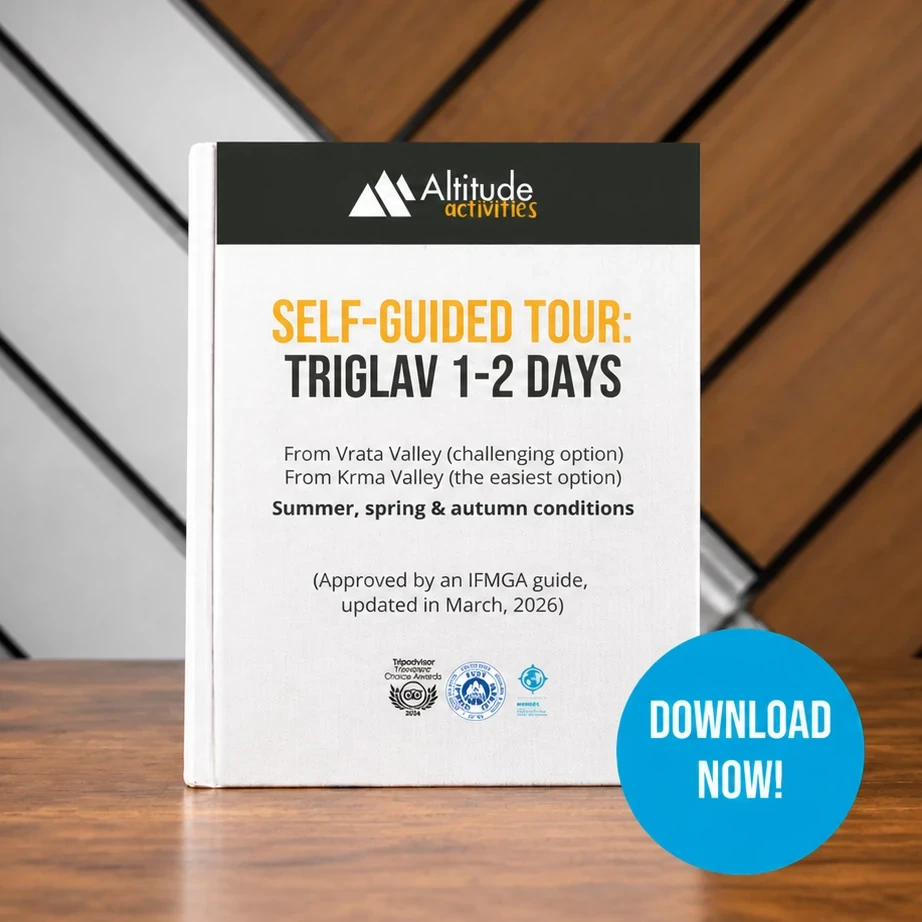
Self-guided tour Triglav 1-2 days

Guided Tours to Mt Triglav vs. Going by Yourself

Here are more concrete guidelines and questions to assess your readiness to tackle Triglav by yourself:

  • Question: How many peaks above 2,000 metres have I successfully climbed?
  • Guideline: Ideally, you should have completed at least 2-3 climbs above 2,000 metres to familiarize yourself with the effects of altitude and the physical demands of high-altitude trekking.
  • Question: How often do I go hiking, particularly in challenging terrains?
  • Guideline: Regular hiking experience, such as going on strenuous hikes at least once a month, is recommended to maintain your fitness level and comfort with varied terrains.
  • Question: Can I handle walking for long durations? How long are my typical hikes?
  • Guideline: You should be comfortable walking uphill for at least 6-8 hours per day with breaks. This is typical for ascents like Triglav where daily walking times can extend due to the terrain and elevation gains.
  • Question: Do I own the necessary gear for a high-altitude climb, and do I know how to use it effectively?
  • Guideline: Ensure you have the essential gear such as appropriate footwear, climbing harness, helmet, weather-appropriate clothing, and safety equipment. Familiarity with the use of each piece of equipment is crucial, particularly in emergency situations.
  • Question: Am I familiar with the unique characteristics and challenges of the Alpine environment?
  • Guideline: Understanding the specific challenges of the Alps, including typical terrain types, common hazards, and local conservation practices, is essential for planning and executing a safe climb.
  • Question: Can I accurately read mountain weather forecasts, and do I understand how to prepare for and react to sudden weather changes?
  • Guideline: Ability to interpret weather conditions and forecasts for high altitudes is vital, as weather in mountainous areas can be unpredictable and change rapidly.
  • Question: Do I have the skill to handle challenging conditions such as storms, high winds, and extreme cold?
  • Guideline: Experience and confidence in dealing with adverse weather conditions are necessary. This includes knowing how to find shelter, alter your route, and protect yourself from the elements.
  • Question: Do I have first-hand information on the current conditions of Triglav, such as trail status and snow coverage?
  • Guideline: Current local knowledge about trail conditions, snow presence (which can persist into late spring), and any recent changes or hazards reported on the routes you plan to take is crucial.
  • Question: Am I skilled in navigating the mountains even in foggy or poor visibility conditions?
  • Guideline: Proficiency in using navigation tools like maps, compasses, and GPS devices in low visibility conditions is essential for ensuring you can maintain your route without visual landmarks.
  • Question: Have I hiked on a ridge before, and how did I handle the exposure?
  • Guideline: Previous experience on ridges is valuable for a climb like Triglav. If you’ve successfully hiked ridges without discomfort, you’ll likely be more confident and safe on Triglav’s exposed sections. If this would be your first time or if previous experiences were challenging, consider hiring a guide for additional support and safety.
  • Question: Do I know how to properly use my via ferrata set?
  • Guideline: Familiarity with how to correctly attach and detach the carabiners and energy absorbers to the cable, how to progress safely along the route, and how to handle potential falls are essential skills. If you’re new to using a via ferrata set or unsure about your skills, it’s highly advisable to receive training from a professional or join a guided climb where you can learn these skills under supervision.

These specific metrics will help you evaluate your preparedness for climbing Triglav or similar mountains. If you find yourself lacking in one or more of these areas, hiring a guide could not only enhance your safety but also improve the overall experience by providing expertise and support throughout the climb.

IFMGA Mountain Guide for Mount Triglav Hiking – Is It Worth It?

The IFMGA (International Federation of Mountain Guides Associations) sets the international standard for professional mountain guides. Founded in 1965, it brings together guiding associations from more than 20 countries, and its qualification is the highest a mountain guide can hold.

Altitude Activities is owned by IFMGA mountain guide Matevž, and most of our Triglav guides hold the same qualification. Here is why it matters on Triglav:

  • Extensive training: IFMGA guides complete years of training in rock, snow and ice, rescue and risk management before they can lead clients.
  • International recognition: the qualification is recognised worldwide as the benchmark for mountain guiding.
  • Safety first: your guide assesses the weather, the route and your pace, and decides when it is safe to continue or turn back.
  • Short-roping on the ridge: on the exposed summit section, an IFMGA guide can keep up to 4 guests on a short rope, so you are protected at all times.
  • Local knowledge: our guides live below Triglav and know every route, hut and weather pattern.
  • Tailored pace: your guide adapts the day to your fitness and experience, so you enjoy the climb rather than just survive it.

Ready to climb with a professional? Book the two-day Triglav climb or compare all our Triglav tours.

How Hard Is It to Climb Mount Triglav Via Ferrata?

The final ascent to the summit of Triglav is notably exposed and protected by a fixed via ferrata (iron path). Steel cables and pegs help you move safely across the steep, airy terrain above the Kredarica and Planika huts.

Depending on the conditions, your mountain guide may secure you with a short rope, keeping the group connected and under control. If you go on your own, you should use a via ferrata lanyard to clip onto the fixed cable, which protects you in case of a slip.

You do not need climbing experience for a guided ascent. However, you should be able to hike for 6–8 hours on steep ground and feel comfortable on exposed paths.

IMPORTANT NOTE:

Some experienced climbers choose to climb this section without any protection, but we strongly advise against it. The Julian Alps, and Triglav in particular, see accidents every year. Even experienced climbers can be caught out by a change in the weather, fatigue or a sudden slip.

IMPORTANT NOTE:

It’s important to note that while some more experienced climbers might choose to ascend this part without any protection, this practice is strongly advised against. The Julian Alps, and Triglav in particular, have been the sites of several accidents, underlining the inherent risks of climbing in such exposed areas without adequate safety measures. Even experienced climbers can face unexpected challenges due to changes in weather conditions, fatigue, or sudden slips.

Hire a Guide for Only the Final Stretch of Your Trek

You can hike to the Kredarica or Planika hut at your own pace and, if you are unsure about the exposed final section, hire a guide just for the summit. This saves money while you still have a professional with you on the most challenging part of the climb.

Our Kredarica to Triglav guided summit climb takes 3–5 hours from the hut to the summit and back, with all via ferrata gear included. Prices start from €220 per person.

When is the Best Time to Climb Triglav?

Ideal months for Climbing Mt. Triglav

The best time for Mount Triglav hiking is typically from late June to mid-September. This period offers the most favorable weather conditions, with warmer temperatures and minimal snow on the trails.

Climbing outside this window, especially in late autumn, winter, or early spring, can be risky due to snow, ice, and unpredictable weather. For those interested in winter ascents, it’s crucial to have the right equipment and experience, or to go with a guide.

During the summer months, particularly in July and August, it’s not uncommon for several hundred people to attempt the summit each day. Weekends and public holidays see the highest numbers, as both local enthusiasts and international tourists take advantage of the good weather. If you’re planning a climb, it’s advisable to considerstarting early in the morning to avoid the largest crowds and to choose weekdays rather than weekends if possible.

SAFETY TIP: Beware Of The Afternoon Summer Storms In July And August

In the Julian Alps, especially during Triglav hiking,  the risk of afternoon storms significantly increases during July and August, primarily due to the accumulation of high heat. These storms often manifest quickly, driven by the day’s heat and the area’s complex mountain topography which influences weather patterns. Additionally, the proximity of the sea contributes moisture, which, when it rises up the mountain slopes and cools, leads to the formation of cumulonimbus clouds associated with severe weather conditions.

When planning Triglav hiking during these months, it’s crucial to watch for signs such as darkening skies, a sudden drop in temperature, increasing winds, or the distant rumble of thunder, all of which can indicate an approaching storm. For safety, it’s advisable to start hikes early in the morning, regularly check the weather forecast, know the quickest route to safety, and carry appropriate gear including waterproof clothing and emergency shelter.

When to start Climbing Mount Triglav?

For climbing Triglav, especially during the busy summer months, it’s advisable to start your hike very early in the morning. Aiming to begin your ascent no later than 5:00 AM (or 7:00 AM if you walk with a faster pace) is a good strategy.
Early morning starts help you avoid the peak daytime temperatures, making the hike more comfortable and reducing the risk of heat exhaustion. Cooler temperatures mean your body will require less water to stay hydrated, allowing you to manage your water supply more efficiently throughout the climb. In addition, reaching the summit early can provide you with a more serene experience, allowing you to enjoy the views and tranquility of Triglav before the main crowds arrive.

Triglav Alternatives: Discover Slovenia’s Lesser-Known Peaks

While Triglav is the highest and one of the most iconic mountains in Slovenia, the Triglav National Park and the surrounding regions offer many other impressive hiking opportunities that are often less crowded and equally stunning. If you’re looking for a quieter yet rewarding hiking experience away from the popular Triglav routes, consider: 7 Triglav Lakes Hike, Panoramic Hike to Debela Peč, or hike to Mt. Golica.

For those seeking a more extreme experience, Zeleniške Špice offers a challenging hike with numerous exposed terrains. It is strongly recommended to undertake this hike with a guide to ensure safety and navigate the demanding sections effectively.

Triglav in One Day vs. Triglav in Two days?

This table should help you decide which tour better suits your needs, based on your climbing experience, physical fitness, and what you want to get out of the experience.

Aspect 1-Day Tour 2-Day Tour
Duration: 12-15 hours, completed in one long day Spread over two days, more relaxed pace
Physical Demand: Very high, requires excellent physical condition Moderate, suitable for most people in good health
Pace: Fast-paced, demanding endurance and time management Leisurely, allows for enjoyment and appreciation of the surroundings
Cost (Approx.): from €285 from €330
Experience: Focused on reaching the summit quickly without stops Richer experience with time to absorb the environment
Accomodation: None (no overnight stay) Overnight stay in a mountain hut Kredarica
Safety Considerations: Higher risk due to prolonged physical exertion and less time for acclimatization Lower risk, more time for rest and acclimatization
Recommended For: Experienced climbers, those limited by time Beginners to advanced, those who prefer a more immersive experience

1 Day Tour

Duration 12-15 hours, completed in one long day
Physical Demand Very high, requires excellent physical condition
Pace Fast-paced, demanding endurance and time management
Cost (Approx.) €285
Experience Focused on reaching the summit quickly without stops
Accommodation None (no overnight stay)
Safety Considerations Higher risk due to prolonged physical exertion and less time for acclimatization
Recommended For Experienced climbers, those limited by time

2-Day Tour

Duration Spread over two days, more relaxed pace
Physical Demand Moderate, suitable for most people in good health
Pace Leisurely, allows for enjoyment and appreciation of the surroundings
Cost (Approx.) €330
Experience Richer experience with time to absorb the environment
Accommodation Overnight stay in a mountain hut
Safety Considerations Lower risk, more time for rest and acclimatization
Recommended For Beginners to advanced, those who prefer a more immersive experience

Still unsure? Most hikers choose the two-day Triglav climb. If you are very fit and short on time, the one-day climb is for you. You can also contact us for advice.

The most accurate weather forecast for Triglav Summit hike

The weather in the Julian Alps is known for its unpredictability, with conditions that can change rapidly. To best prepare for a hike or climb, it’s essential to consult the most accurate and recent specialized mountain weather forecasts. We recommend one of the following forecasts:

Current Conditions on Mount Triglav – Live View From The Kredarica Mountain Hut

Before heading to Triglav, it’s crucial to be well-informed about current snow conditions. Consult local outdoor agencies for the latest updates, or at a minimum, view the live webcam from Kredarica—the last hut before the summit—to assess the situation directly. This preparation ensures your safety and helps in planning the most appropriate route and timing for your climb.

If you’re unsure about the current weather or other conditions on Triglav, please contact us for a free consultation. Considerations before your hike should include trail conditions such as snow or ice, visibility issues like fog, extreme temperature changes, avalanche risks, and crowd levels. Being aware of these factors can help ensure a safer and more enjoyable trek.

Mount Triglav Route Options: Which One to Choose?

While some routes are more technical, others longer, and some more scenic, your options become limited in the final hour of the climb. This is because all paths eventually converge on the summit via one of three approaches: either from one of the two huts located just below the peak or through Triglavska Škrbina.

The final push to Mount Triglav is crucial. All three final approaches are secured Via Ferratas, which means that the last section of every route to Triglav is steep and exposed. This implies that a strong fear of heights can be a significant hindrance, as it’s impossible to choose a route that avoids these more challenging sections.

With these considerations in mind, let’s explore the best routes to Triglav.

The Easiest Way to Triglav: Hike from the Krma Valley

The easiest hiking route to Triglav starts in the Krma Valley near Mojstrana. It offers the most gradual ascent, with a well-marked trail and a steady incline up to the Kredarica hut, the highest mountain hut in Slovenia at 2,515 m.

From Kredarica, the final stretch to the summit is a secured via ferrata section, which you can complete safely with the right equipment or a guide. This is also the route we use on most of our guided climbs, including the two-day Triglav tour with a night at the hut.

For a detailed account, including tips, timings and what to expect in spring conditions, read our full trip report below.

Hire a Professional Climbing Guide for Triglav North Face

For those who are physically fit and eager for a climbing challenge rather than a traditional hike, the northern wall of Triglav offers several exhilarating options. Climbers can choose from a variety of routes, each providing a unique experience tailored to different skill levels. These include the Bavarian Route, Long German Route, Slovenian Route, The Čop’s Pillar, The Face of Sphinx, Short German Route.

What to pack for Triglav? Checklist for Summer Ascends

Packing for a trek to Mount Triglav requires careful consideration to ensure safety and comfort. Here’s a comprehensive checklist:

✔ Equipment: Mountaineering helmet, climbing harness, via ferrata lanyard, trekking poles.

✔ Footwear: Choose high boots for ankle protection (especially beginners) with ribbed, Vibram soles for enhanced grip. Break in new shoes with a test hike. Hiking socks plus an extra pair are essential for multi-day treks.

✔ Clothing: Hiking trousers, breathable long and short-sleeved shirts, plus an extra layering.

✔ Outerwear: Water and wind repellent jacket and a thin down jacket.

✔ Headgear: Cap and thin gloves, useful even in early summer due to temperature changes.

✔ Food and Water: Bring adequate supplies, adjusting for the duration of your hike. A common recommendation is to plan on about 1,5 to 3 liter of water per day of hiking.*

✔ Sun protection: Sun cream, sunglasses with UV protection.

✔ Personal Items: Toilet paper, passport or ID and cash (most mountain huts do not except credit cards).

✔ Backpack: 20-30 liters for day hikes, 30 – 40 liters for 2- day hikes

✔ Navigation: Offline map, compass, and GPS, especially important for glacier areas. Keep in mind there might be no phone reception in the Julian Alps.

✔ Emergency Gear: Bivvy bag, aluminum foil, personal first aid kit, pocket knife.

✔ Lighting: Headlamp with extra batteries.

✔ Communication: Fully charged cell phone plus a charger.

*Water Availability: There is no running water available at Kredarica or Planika Hut, which is a consideration if staying overnight. You can buy bottled water at the bar if the hut is open.

Always adjust your pack according to the season and weather forecast. Double-check all gear before embarking on your journey.

For more tips on what to bring on your hiking trip and how to pack effectively, check out our comprehensive blog post.

Essential Gear Rental for Triglav: Book in Advance for a Safe and Hassle-Free Hike

Having the right gear, particularly safety equipment and proper footwear, is crucial when tackling a hike as challenging as Triglav. Adequate preparation with the appropriate equipment can significantly enhance both your safety and your overall experience on the mountain. If you don’t have the necessary gear or prefer to travel light, everything you need can be rented from our office in Bled. To guarantee availability, especially during peak seasons, it is advisable to book these items in advance. This approach not only ensures you are well-equipped but also allows for a more streamlined and hassle-free preparation for your adventure.

Which are the Best Mountain Huts to Stay in Mount Triglav?

The Kredarica Hut and Planika Hut are both popular stops for climbers heading to the summit of Mount Triglav, each offering unique features and facilities:

Kredarica Hut (Triglavski dom na Kredarici)

  • Altitude: Situated at 2515 meters, it is the highest hut in Slovenia.
  • Capacity: It is the largest hut in the Julian Alps, accommodating over 340 hikers in rooms and dormitories.
  • Proximity to Summit: It’s the closest hut to Triglav’s summit, approximately 1 – 2 hour away.
  • Facilities: Due to its size, it’s well-equipped to handle many guests and typically serves as a major hub for climbers.
  • Accessibility: Kredarica can be accessed from several trails with varying degrees of difficulty and length.
  • Water Availability: There is no running water available at Kredarica, which is a consideration if staying overnight. You can buy bottled water at the bar if the hut is open.

Planika Hut (Dom Planika pod Triglavom)

  • Altitude: Located at 2401 meters.
  • Capacity: Smaller and more intimate, it houses up to 143 hikers.
  • Proximity to Summit: It takes about 1 hour and 30 minutes to 2 hours and a half to reach the summit from here.
  • Facilities: Known for its cozy and welcoming atmosphere, Planika offers a more ‘home-like’ feel, though with basic amenities.
  • Water Availability: There is no running water available.

Dolič Hut (Koča na Doliču)

  • Altitude: Positioned at 2151 meters.
  • Capacity: Accommodates a limited number of hikers, ensuring a quieter environment.
  • Proximity to Summit: About 3 hours from the summit of Triglav.
  • Facilities: Offers basic amenities for a comfortable stay.
  • Accessibility: Suitable for experienced hikers seeking a challenging route.
  • Water Availability: No running water; plan accordingly for overnight stays.

Vodnik Hut (Vodnikov dom na Velem polju)

  • Altitude: Located at 1820 meters.
  • Capacity: Provides modest accommodation for hikers.
  • Proximity to Summit: Approximately 6 hours from the summit of Triglav.
  • Facilities: Equipped with essential amenities for hikers.
  • Accessibility: Accessible via less strenuous trails, suitable for a wider range of hikers.
  • Water Availability: Fresh water available, making it a convenient stopover.

Stanič Hut (Dom Valentina Staniča pod Triglavom)

  • Altitude: Situated at 2323 meters.
  • Capacity: Offers accommodations for a moderate number of hikers.
  • Proximity to Summit: Roughly 2 hours from the summit of Triglav.
  • Facilities: Basic amenities provided for climbers and hikers.
  • Accessibility: Access involves a moderately challenging trail, suitable for most experienced hikers.
  • Water Availability: Limited water supply; visitors are advised to carry sufficient water.

Triglav National Park – Hiking Rules You Should Know

Hiking in Triglav National Park is governed by specific rules and guidelines to ensure both hiker safety and environmental conservation. Here’s a comprehensive overview of what you need to know:

Marked Trails: It’s essential to stick to marked trails, which are indicated by signs and painted markings. This not only ensures your safety but also helps in preserving the natural environment​​.

Weather Preparedness: The alpine climate means cold winters and moderate summers, with mountain weather being unpredictable. Always be prepared for sudden changes and consult local forecasts before setting out.

Mountain Huts: The park offers mountain huts that provide food, shelter, and accommodations. Advance booking is recommended during peak seasons. Some huts may be closed off-season, so always verify their availability.

Safety and Equipment: Wear appropriate clothing and footwear, carry all needed equipment, and have sufficient water and snacks. In emergencies, dial 112 for assistance​​.

Leave No Trace: To maintain the park’s beauty, practice Leave No Trace principles. This includes carrying out all trash, staying on marked trails, and avoiding disturbing wildlife and vegetation​​.

Fees and Permits: No entrance fee is required to enter the park. However, fees may be applicable for parking or overnight stays in mountain huts, where you will need cash (not cards). Climbing Mount Triglav doesn’t require special permits.

Environmental Protection: To protect the park’s natural resources, activities such as camping outside designated areas, lighting open fires, picking plants, and disturbing wildlife are prohibited​​​​.

Drone Use: The use of drones is generally prohibited in the park to avoid disturbing wildlife and ensure visitors’ privacy.

Slovenia Mountain Rescue – Emergency Number: 112

In emergency situations on Mount Triglav, the most important thing is to stay calm and take appropriate steps to ensure your safety and that of others. 

Here are the key actions to follow:

Call for Help: If you find yourself in a situation beyond your control or if someone is injured, call the emergency number 112. This number is accessible throughout Slovenia and connects you to the emergency services, including mountain rescue.

Provide Accurate Information: When calling for help, be as precise as possible about your location, the nature of the emergency, the number of people involved, and the type of injuries sustained. This will enable the rescue team to prepare adequately.

Stay Put and Visible: Unless it’s unsafe to do so, stay where you are after calling for help. Moving around can make it harder for rescuers to locate you. Try to make yourself as visible as possible to the rescue team.

Use Emergency Equipment: If you have an emergency bivvy or blanket, use it to keep warm. If you’re in a group, stay together and use body heat to stay warm.

Be Prepared: Carrying a basic first aid kit, a whistle, a flashlight or headlamp, and a mirror can be useful in emergencies. These items can help provide first aid and signal rescuers.

Costs of Rescue: In Slovenia, mountain rescue services are generally free of charge as the government and donations fund them. However, there may be costs associated with medical treatment or transportation to a hospital if required. It’s advisable to have travel insurance that covers mountain rescue and medical expenses.

Insurance: If you are a member of an alpine club or have specific outdoor adventure insurance, it can cover additional costs that may arise from a rescue operation. It’s always a good idea to check your insurance details before hiking.

Emergency Shelters: Know the locations of emergency shelters and huts on your route. In case of severe weather or if you cannot proceed, these can provide temporary refuge.

Join a group Mount Triglav Hike

Experience the thrill of climbing Mount Triglav safely and efficiently with our expert-guided tours. Our professional guides handle the route planning and navigation, so you can focus on the climb and enjoy the views without the stress of getting lost or facing unexpected challenges. Secure your spot now and make your Mt. Triglav ascent a memorable and worry-free adventure.

FAQ

Yes, climbing Triglav without a guide is possible if you are an experienced mountain hiker who is comfortable on exposed, secured routes and knows how to use a via ferrata set. If you have little experience in the high mountains, a guide is strongly recommended for safety, navigation and decisions about the weather.

Our guided Triglav tours start from €220 per person for the summit climb from Kredarica. The two-day climb starts from €330, the one-day climb and the two-day group climb on Wednesdays and Sundays from €285, and the winter ascent from €490. Transport from our office in Bled and all technical gear are included. Mountain hut accommodation and food are paid separately at the hut.

Yes, if you are very fit. The whole day takes 12–15 hours door to door from Bled, including around 6–10 hours of hiking at a fast pace or 8–12 hours at a slower pace, with about 1,950 m of elevation gain from the Krma Valley. Most hikers prefer the two-day tour with a night in a mountain hut, as it is less tiring and you reach the summit in the calm morning hours.

Your IFMGA mountain guide, transport from our office in Bled and the technical gear: helmet, harness and via ferrata set. Pick-up from your accommodation is available for a small extra fee. You bring hiking boots, warm and waterproof clothing, water and snacks.

Yes, children from 12 years old can join our guided Triglav climbs when accompanied by a parent. They should be fit, used to long hikes and comfortable on exposed terrain. For families we usually recommend the two-day tour, as the effort is spread over two days.

We mostly climb through the Krma Valley via the Kredarica hut, which is the most gradual approach. Your guide may choose another route, such as Vrata or Pokljuka, depending on the conditions and the group.

Start by building your fitness with long uphill hikes of 6–8 hours, ideally on rocky terrain. Plan your climb for July to September, when the trail is mostly free of snow. As a beginner, the safest choice is a guided two-day climb: your guide provides the via ferrata gear, sets the pace and keeps you on a short rope on the exposed summit ridge.

The best time to climb Mount Triglav is in summer, from late June to September. The weather is warmer, the mountain huts are open and the risk of snow and ice on the trail is much lower. In July and August, start early to avoid afternoon thunderstorms.

Check the weather forecast before you set out and start early in the day to avoid afternoon storms. Wear proper hiking boots, carry warm and waterproof layers, and stay on marked trails. Use a via ferrata set on the summit ridge, and if you are not experienced in the high mountains, climb with a guide.

There are several mountain huts on the routes to Triglav. Triglavski dom na Kredarici is the highest hut in Slovenia and the most common base for the summit, while Planika hut is smaller and quieter. Book in advance, especially in July and August. In the valley, Bled, Mojstrana and Kranjska Gora are good bases.

No, there is no entrance fee for Triglav National Park. The park is open to the public free of charge.

There is no entrance fee for climbing Triglav. However, you may need to pay for parking at the trailhead, mountain hut accommodation, food or a mountain guide.

No permit is required to hike Mount Triglav. However, you must follow the rules of Triglav National Park: stay on marked trails, do not disturb wildlife and take all your litter with you.

No. Camping outside designated campsites is not allowed in Slovenia, including Triglav National Park. For overnight stays in the mountains, use the mountain huts.

We do not recommend it. The terrain is rocky and can be slippery, especially near the summit. Hiking boots with a good grip and ankle support are essential for a safe climb.

No, there is no cable car to Triglav. You can, however, take the Vogel cable car above Lake Bohinj for a good view of Triglav and the surrounding Julian Alps.

Accidents happen on Triglav every year, mostly because of poor preparation, unsuitable footwear or bad weather. Check the forecast, use a via ferrata set on the summit ridge and climb with a guide if you are not experienced in the high mountains.

Hiking at night on Triglav is not recommended because of the higher risk of getting lost or injured. Early morning starts with a headlamp are common, but plan to be on the exposed summit ridge in daylight.

Mountain rescue can be expensive, especially if a helicopter is needed. Make sure you have insurance that covers mountain rescue and hiking in the high mountains. In an emergency, call 112.

Not always. Many standard travel insurance policies do not cover mountain hiking or via ferrata routes. Check that your policy specifically includes mountain hiking and mountain rescue before you climb Triglav.

The Kredarica hut serves traditional Slovenian mountain food, such as hearty stews, soups and meat dishes, as well as simpler options like sandwiches and snacks.

Vegan options at Kredarica may be limited because of its remote location. Contact the hut in advance to ask about the menu, or bring some of your own food.

The Kredarica hut is usually open from late June to September, depending on the snow and weather. Exact dates change each year, so check with the hut before you go.

Yes, on very clear days you can see the Adriatic Sea from the summit of Triglav. The view stretches across the Julian Alps and south towards the coast. The clearest views are usually early in the morning.

Flying drones in Triglav National Park is generally prohibited to protect wildlife and the natural environment. Permission is usually granted only for professional or research purposes and must be obtained in advance from the park authority.

100% Money Back Guarantee

100% Money Back Guarantee

Nature is unpredictable. Since we sell outdoor activities there are no guarantees that the weather will hold. In case of cancellation due to rain or other unfavorable weather conditions you will be offered an alternative activity or full money refund.

Capture the moments

Free photos

During our activities we take free photos of you from different angles so you don’t have to worry about that.

Excellent equipment

You can rent the best quality equipment in our agency.

Exceptional team

We are nature enthusiasts with a breadth of knowledge about the activities and the region. If you are ready for your next adventure, contact us! You won’t regret it!

Member of IFMGA Mountain guides

We are a member of IFMGA (International Federation of Mountain Guides Association)

Guaranteed personal approach and safety

All our mountain tours are performed in small groups. This enables us to have more personal approach and we can take more time for each individual.

Looking forward to (receiving) your feedback

We are happy to receive all your comments about our adventures.

Altitude Activities is a proud recipient of a TripAdvisor 2024 Certificate of Excellence. Thank you all for the great reviews!

Trip Advisor 5 stars

The best thing ever. I took my old boss to experience Slovenia in one day. And boy I am happy I chose Altitude Activities to do so. Our tour guide Jerry was awesome, funny and you could just see he knows what he is doing. We went to the canyon of Jermanka and even though there is a drop almost 45m high we felt extremely safe. Overall highly suggest going canyoning with Altitude Activities

TripAdvisor logo small

JURE U

AUGUST 23, 2024